

In short
All four chemical anchors deliver the same design result in this case. All four pass with the same governing check: concrete edge failure in shear combined with concrete cone in tension. The differences between the four products are small and do not change the result. The edge distance and the concrete decide the result, so the better anchor here is the one that wins on availability and cost.
On this page
- Which anchors were compared, and on what basis?
- What connection was used to compare them?
- What do the ETAs say about each anchor?
- Which anchor performs better at 200 mm embedment?
- How do the anchors compare on working life and temperature?
- When could a different anchor be the better choice?
- So which chemical anchor is better?
- How to decide which chemical anchor is better for your project
- How SHM360 helps
- Sources
Which chemical anchor Akalm, Fischer, Hilti or Index is better? To answer that, this guide applies the same EN 1992-4 verification to four types of bonded epoxy anchors used to fix a steel base plate to concrete, comparing each failure mode to distinguish anchor-dependent results from those governed by the concrete and connection geometry. After reading it you should be able to tell, for a connection of this type, whether choosing the anchor is a design decision or a procurement one.
Which anchors were compared, and on what basis?
Products. Four bonded epoxy anchor systems, M20 size, with data taken from their European Technical Assessments:
| Product | Anchor ETA |
|---|---|
| Akalm AIT-VMK-RE 585 | ETA-26/0126 |
| Fischer FIS EM Plus | ETA-17/0979 |
| Hilti HIT-RE 500 V4 | ETA-20/0541 |
| Index MOPUR3 | ETA-17/0659 |
Design method. EN 1992-4:2018, static loading. The base plate is taken as rigid: plate bending and the shear path from the column into the plate are not part of the check. Seismic, fire and fatigue are outside the scope.
What connection was used to compare them?
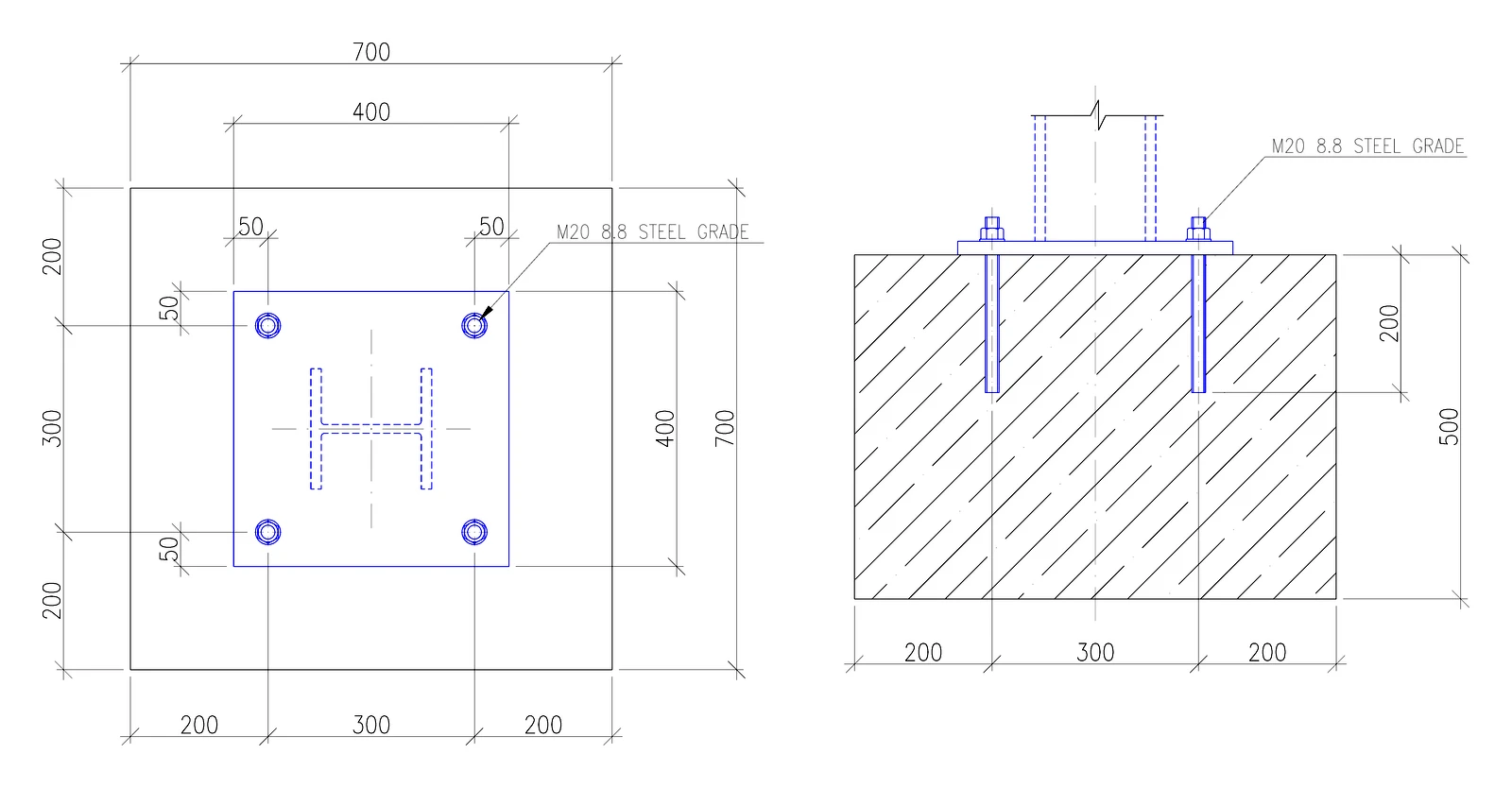
| Input | Value |
|---|---|
| Base plate | 400 × 400 × 20 mm, no stand-off |
| Anchors | 4 × M20 threaded rod, grade 8.8 |
| Effective embedment hef | 200 mm |
| Edge distance c | 200 mm to all four edges |
| Member thickness h | 500 mm |
| Concrete | C30/37, uncracked |
| Working life | 50 years |
| Service temperature | 40 °C short-term / 24 °C long-term |
| Design loads (ULS) | NEd = 80 kN tension; VEd = 30 kN shear |
What do the ETAs say about each anchor?
M20, uncracked concrete. Source: the four ETAs.
| Parameter | Akalm AIT-VMK-RE 585 | Fischer FIS EM Plus | Hilti HIT-RE 500 V4 | Index MOPUR3 |
|---|---|---|---|---|
| τRk,ucr, base value (N/mm²) | 16.0 | 16.7 | 16.0 | 12.0 |
| smin / cmin (mm) | 90 / 55 | 85 / 55 | 90 / 55 | 50 / 50 |
In this connection a chemical anchor can be better or worse mainly through one quantity: the characteristic bond resistance τRk, which EN 1992-4 uses in the combined pull-out and concrete failure mode (clause 7.2.1.6). The ETA also sets the minimum spacing, edge distance and member thickness and the splitting parameters, which is why splitting differs slightly between products. That explains most of what follows.
Which anchor performs better at 200 mm embedment?
Design resistance of each check, in kN, for the anchor group; steel failure values are per anchor. Utilisation is design load divided by design resistance for the governing check; a value below 1.00 passes. Calculated per EN 1992-4:2018.
| Check | Akalm | Fischer | Hilti | Index |
|---|---|---|---|---|
| Steel failure, tension | 130.7 | 130.7 | 130.7 | 130.7 |
| Comb. pull-out and concrete failure | 286.4 | 294.9 | 275.1 | 171.5 |
| Concrete cone failure | 189.4 | 189.4 | 189.4 | 189.4 |
| Splitting failure | 302.2 | 302.2 | 305.5 | 305.5 |
| Utilisation, tension | 0.42 | 0.42 | 0.42 | 0.47 |
| Steel failure, shear | 78.4 | 78.4 | 78.4 | 78.4 |
| Concrete pry-out failure | 378.8 | 378.8 | 378.8 | 342.9 |
| Concrete edge failure | 49.1 | 49.1 | 49.1 | 49.1 |
| Utilisation, shear | 0.61 | 0.61 | 0.61 | 0.61 |
| Utilisation, combined | 0.75 | 0.75 | 0.75 | 0.80 |
What the table shows. All four chemical anchors deliver the same design result in this case. The decisive check is the interaction of concrete edge failure in shear with concrete cone failure in tension (EN 1992-4, 7.2.3), and it is almost identical for all products.
How do the anchors compare on working life and temperature?
| Akalm | Fischer | Hilti | Index | |
|---|---|---|---|---|
| Working lives (ETA) | 50 / 100 years | 50 / 100 / 120 years | 50 / 100 / 120 years | 50 / 100 years |
| Temp. range (ETA) | 80 / 50 °C | 72 / 50 °C | 75 / 55 °C | 70 / 50 °C |
For Fischer and Hilti, the 120-year working life is assessed in separate ETAs (ETA-25/1097 and ETA-25/0752).
When could a different anchor be the better choice?
- Cracked concrete. This comparison assumed uncracked concrete. In cracked concrete the ETA bond values differ more between the four products (τRk,cr from 7.0 to 10.4 N/mm² at C30/37) and the answer can change.
- Sustained load. No sustained load was assumed. With a sustained-load component, the ETA factor ψ⁰sus (0.72 to 1.00 across the four) applies and separates the products.
- Other edge distances. The 200 mm edge distance is what fixes this result. A different edge distance, spacing or anchor size changes the governing mode and may change the ranking.
So which chemical anchor is better?
All four anchors pass with the same governing check. For three of them the design is identical in every number that decides; the fourth passes with a slightly higher utilisation because its lower ETA bond value makes bond the largest tension mode, but the connection is still fixed by the edge distance and the concrete.
How to decide which chemical anchor is better for your project
- For bonded anchors check which tension mode governs before comparing anchors: if it is the concrete cone or splitting, the resin is not a design variable.
- Bond resistance is not monotonic in hef when edges are close. Deeper is not automatically stronger.
- Compare anchors at the same ETA temperature range, the same hole condition and the same working life.
- Re-run the comparison whenever the concrete condition, the load type or the edge distance changes. One passing case is not a general ranking.
How SHM360 helps
AnchorDesign360™ is SHM360's tool for post-installed connections in existing concrete. It works in three steps: design, compare, choose.

- Design. Model the connection and check it to the right document: base plate anchors to EN 1992-4, post-installed rebar end anchorage and lap splices to EN 1992-1-1 with EOTA TR 023, and end anchorage and moment-resisting connections to EOTA TR 069 where the product is assessed for it. Each check uses the product's own ETA data.
- Compare. Run the same design across epoxy and vinyl ester mortars from different manufacturers and see side by side which products work for your case and how they perform.
- Choose. Select the product that suits the job, with the design basis behind the choice.
Sources
- ETA-26/0126, Akalm AIT-VMK-RE 585 — issued 16 February 2026
- ETA-17/0979, Fischer FIS EM Plus — issued 12 February 2026
- ETA-20/0541, Hilti HIT-RE 500 V4 — issued 10 September 2025
- ETA-17/0659, Index MOPUR3 — issued 22 September 2021
- EN 1992-4:2018, Eurocode 2 — Design of concrete structures — Part 4: Design of fastenings for use in concrete
Frequently asked questions
Which chemical anchor is better: Akalm, Fischer, Hilti or Index?
For the base plate in this guide, none is better in a way that changes the design. All four pass with the same governing check. The differences between them are small and do not change the result. The choice can be made on availability and cost.
When does the choice of chemical anchor matter?
When bond governs: deep embedment far from edges, cracked concrete or sustained loads. There the ETA bond values differ more and the comparison must be re-run for that case.
What makes one chemical anchor better than another in design?
Mainly the characteristic bond resistance τRk in its ETA, used in the combined pull-out and concrete failure check (EN 1992-4, clause 7.2.1.6). The ETA also sets minimum spacing, edge distance and member thickness, and the splitting parameters.
This article is general technical information, not project advice. Your project specification, the applicable standards and the engineer of record govern.

